
Table of Contents
Spring Garden Road has never been shy about what it is. Running through the heart of downtown Halifax, it’s one of the city’s most traveled corridors, the kind of street where shoppers, residents, and cruise ship visitors all move together, past storefronts and coffee shops and the iron gates of the Public Gardens. It’s busy by design.
The Spring Garden Area Business Association has spent years trying to make that busyness feel like something. The not-for-profit represents roughly 200 businesses along the corridor and serves a surrounding community of more than 300,000 people. Their mandate is community-first: events that are low-cost or free, accessible to families, and built to make the street feel like more than a place to pass through. Children’s festivals, holiday street closures, and outdoor activations that blend music, performance, and light.
The only thing that kept getting in the way was power.
The Challenge: Power Was the Ceiling for Every Outdoor Event
In a dense urban environment without reliable outdoor infrastructure, delivering live event power on Spring Garden Road meant making compromises. Extension cords running across pedestrian walkways. Cable mats for visitors to navigate around. A single central power source that dictated where activations could and couldn’t live. And underneath all of it, the sound and smell that comes standard with diesel and gas-powered equipment: a low, constant presence that neither organizers nor guests really notice until it’s gone.
Scott MacKendrick, the Association’s Communications and Events Coordinator, knew the setup well. He’d built events around it for years.
“Power was such a limiting resource for us. It determined everything about what we could and couldn’t do, where we could run a DJ booth, whether we could program multiple zones at once, and how much of the street we could actually activate.”
Scott MacKendrick, Communications and Events Coordinator
The Association wanted to do more. The question was whether the power could follow.

First Deployment: Two DJ Booths, No Cord Hazards, One Petting Pen
The first time the Association worked with Star Power Atlantic was for a children’s festival in a small downtown park. The ask was straightforward: power for two separate DJ booths, spread across different corners of the space.
Under a traditional setup, that would have meant running on a single source and making a choice, one zone of music, or a cord long enough to create a hazard across a family-traffic area. With Voltstack 5k units positioned next to each booth, the Association could program the whole park independently. No cable mats. No centralized compromise. No generator noise in the background.
MacKendrick remembers one detail that stuck with him. The festival had set up a petting pen with goats, donkeys, and rabbits for families who don’t often encounter farm animals in the city. Loud, sudden noise around animals is an obvious problem. The Voltstack 5k produces minimal audible output and zero local emissions.
“Having that kind of silence in the area was really excellent, for the people enjoying the experience, but also for the animals. It’s not something you’d think about right away, but once you do, it makes sense.”
Scott MacKendrick, Communications and Events Coordinator
Scaling Up: Closing the Street, Opening the Experience
After the children’s festival, the Association began thinking bigger. For the first time, they closed Spring Garden Road from the Public Gardens to the library for a holiday activation that was equal parts community event and immersive installation. Fire pits. Hot chocolate. A DJ set. Holiday light arches and seasonal displays designed to make the street feel like the exterior of a film set, the kind of event where people slow down and linger.
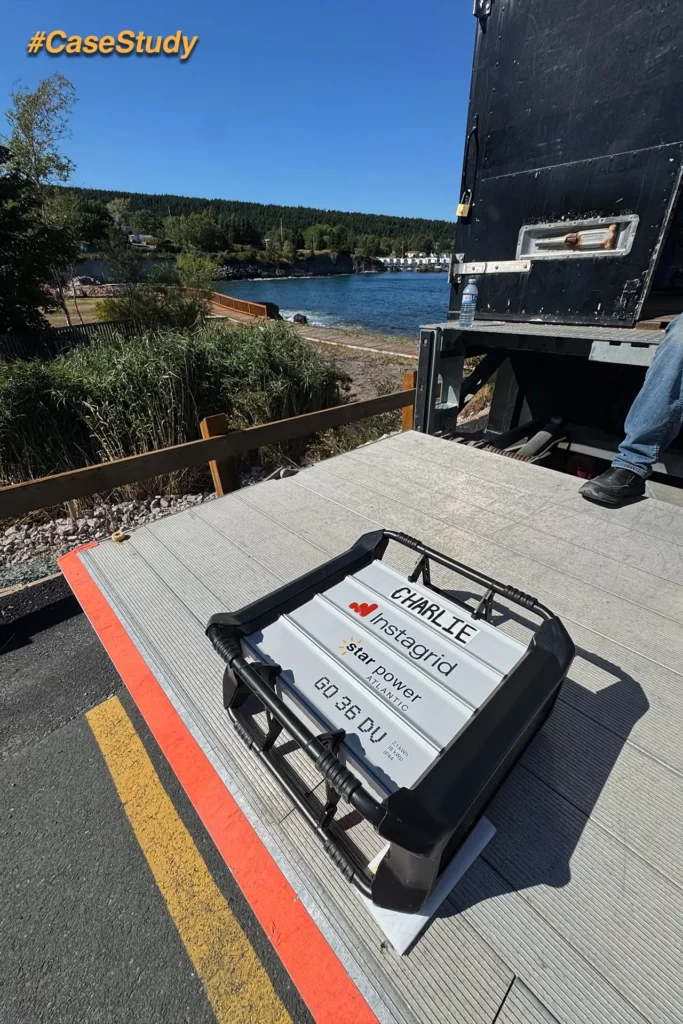
Powering it meant distributing clean, silent power throughout the corridor: the lighting displays, the music, the ambient elements that held the experience together. A combination of Voltstack 5k and Instagrid GO portable battery units allowed the team to place power exactly where each activation needed it, beside a light arch here and behind a seasonal display there, without running cable across the pedestrian path or anchoring the setup to a single fixed zone.
“The mobility is what really changes things. We can place them wherever we want. We can program the whole street. And nobody has to watch their feet.”
Scott MacKendrick, Communications and Events Coordinator
The street was quiet in a way it hadn’t been before: not empty, but unburdened. Visitors moved through it freely, without the hum of a diesel unit in the background.
A Quieter Event for the Families Who Needed It Most
MacKendrick hadn’t anticipated who would notice most.
After the holiday activation, a family stopped to tell him about their experience near one of the lit arches. No exhaust. No engine noise. For their young child, for whom loud and unpredictable sounds can be overwhelming, the quiet wasn’t incidental. It changed how the whole event felt.
“I don’t want to say they experienced it at a different level. But they were just kind of carried into a different experience. And that’s what made me take notice.”
Scott MacKendrick, Communications and Events Coordinator
It’s a reminder that removing the things that don’t need to be there, fumes, noise, and trip hazards, turns out to remove barriers that nobody had stopped to name. The event becomes quietly more inclusive. Not because accessibility was the headline, but because the equipment stopped getting in the way.
The Results: A Street That Programs Itself
Two years into working with Star Power Atlantic, the Association’s wins are operational, atmospheric, and, for the holiday corridor activation, measurable.
The holiday street closure drew 20.2 kWh of energy across the lighting displays and the DJ booth. Because the Voltstack 5k and Instagrid GO units arrived solar-charged, the net electricity cost for the event was effectively zero, at grid rates, which works out to roughly $3.50. Running six comparable gas-powered units for the same event would have consumed an estimated 45 liters of fuel, worth approximately $87 at current Nova Scotia pump prices, and produced around 104 kg of carbon emissions. For context, that is roughly the equivalent of driving a gas-powered truck 400 kilometers.
The mobility of the Voltstack 5k and Instagrid GO units also means the team can design for the experience first and solve for power second. That reversal matters. Event programming typically starts with “what can we run from here?” With emissions-free live event power that can be placed anywhere along the street, it starts with “what do we want people to feel?”
There were no trip hazards. No cable mats for families to navigate. No exhaust drifting through the food zone. And the background hum, the one that event-goers spend years tuning out without realizing it, was gone.
“Once it all disappears, people focus on what their family and friends are actually saying, on what the musicians are playing. It creates a whole new atmosphere… Without the Voltstacks and the Instagrids, there would be no events on Spring Garden, not at this level.”
Scott MacKendrick, Communications and Events Coordinator
Working with Star Power Atlantic, he adds, has felt less like sourcing equipment and more like finding a collaborator whose values align with the Association’s. Accessible, community-minded, and genuinely invested in whether the event works. For event organizers across Eastern and Atlantic Canada seeking clean, silent live-event power solutions, that alignment makes a practical difference from the outset.
What the Street Sounds Like Now
Spring Garden Road’s community events are not large-budget productions. They are not-for-profit, community-first activations, built for the people who live nearby and the businesses they pass on the way. The values driving them, accessible, free, local, are the same values that made portable, silent, emissions-free battery power the right fit. Not because the Association needed a sustainability statement, but because the equipment supported the experience without competing with it.
That distinction is where clean live-event power makes its most lasting impression. It is not just about what the spec sheet promises. It is about what disappears from the event itself: the fumes, the engine noise, the cord hazards, the limits on where programming can happen. And in that absence, people notice the things they came for. A child walking through a holiday arch on a closed street. Music that can actually be heard. A public space that feels easier to move through, easier to stay in, and easier to enjoy.