Table of Contents
A film does not arrive at SXSW by accident.
Before the badges, the buzz, and the premiere slot in Austin, there are the smaller decisions that make a production possible. Where the crew parks. How the lights get charged. What happens when a location has limited power. Whether a set leaves behind noise, exhaust, and friction, or moves through a community with a lighter touch.
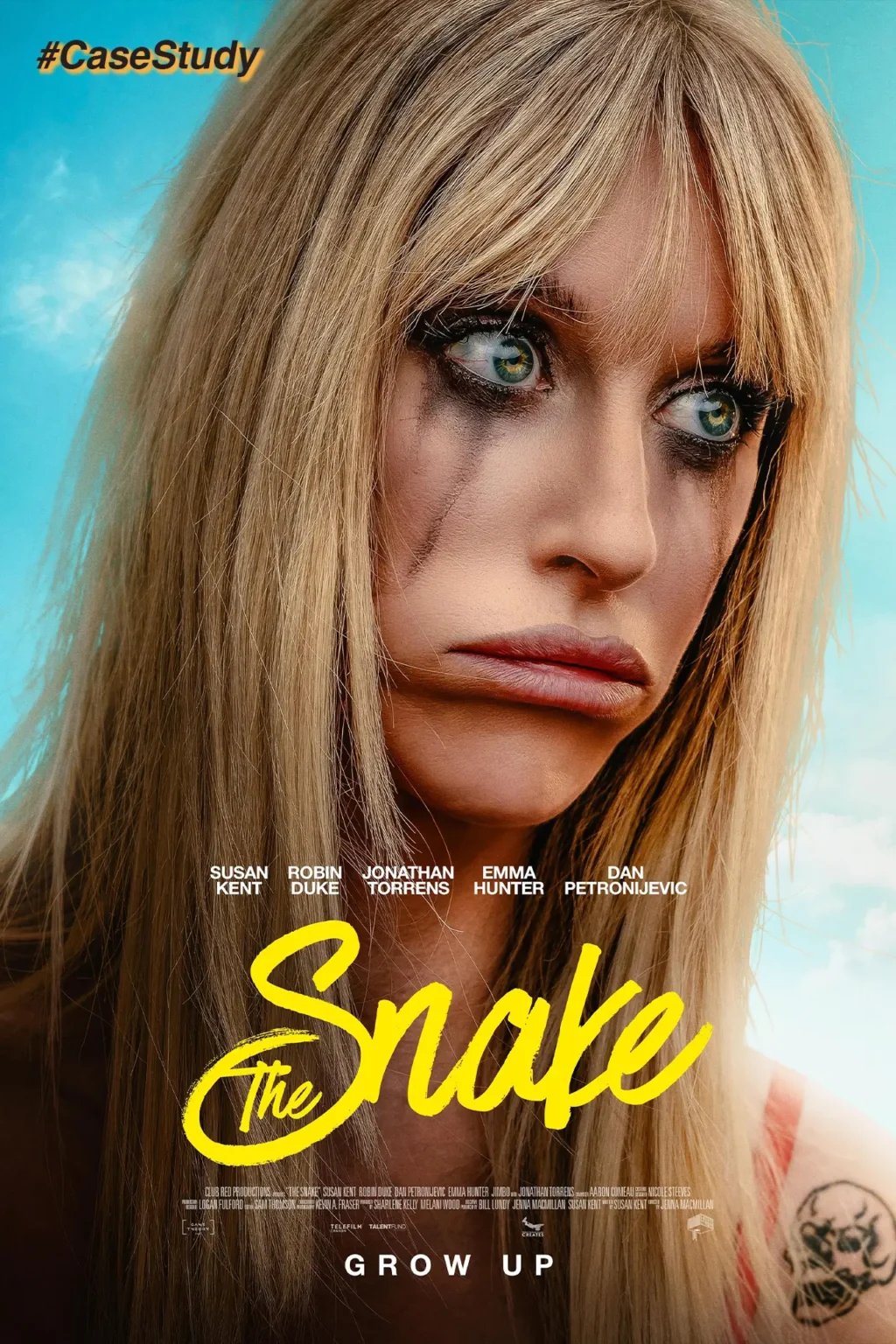
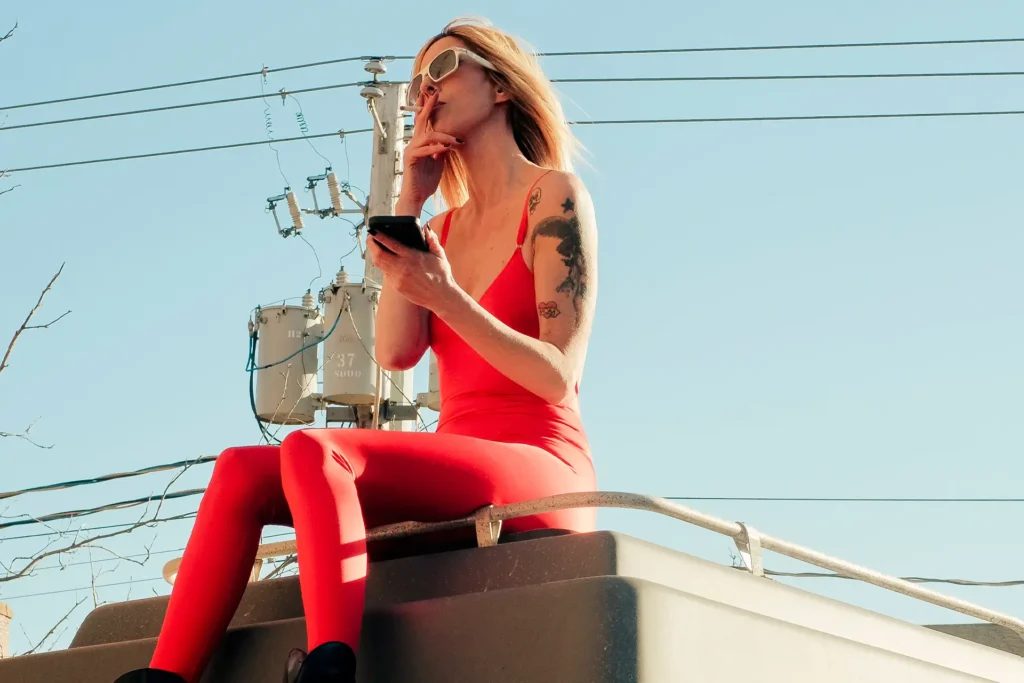
For The Snake, those decisions mattered. Directed by Jenna MacMillan and produced by Sharlene Kelly and Melani Wood, the Canadian feature will have its world premiere at the 2026 SXSW Film & TV Festival in the Narrative Feature Competition this month. But before The Snake heads to Texas, its production offers another story worth telling here at home.
Shot as a Telefilm Talent to Watch project, the film was made with emerging-feature ambition, a modest budget, and a clear sense of values. The team wanted to make the movie responsibly. That included how they approached power.
The Challenge: How Do You Power a Lean Production Without Becoming a Burden?
Independent film crews are used to making things work. If a location has limited electrical access, someone finds a workaround. A generator gets pushed farther from the set. More cable gets run. A fuel can appears. Someone asks the neighbours for a favour. It is resourceful, but it is rarely elegant.
Melani Wood, who served as both producer and first assistant director on The Snake, knows that rhythm well.
"I’ve definitely been on a bunch of film sets where it’s like, the putt putt generator’s positioned as far away from set as possible, running cable as far as you can so that sound doesn’t hate it, but you can access power.”
Melani Wood, Producer
That was not the kind of production the team wanted to run.
Filmed across PEI, including downtown Charlottetown, The Snake involved exterior day and night scenes, plus a key loft location where power was not always straightforward. The production wanted to be mindful of noise, fuel use, logistics, and its impact on the surrounding community. It also marked a small first for the region: the Voltstack unit used on the production was the first of its kind deployed on a PEI film set, introduced by a crew that included several technicians from Nova Scotia already familiar with the technology. As Wood put it, the goal was not just to avoid disruption, but to be “an asset to the community.”
A Production Philosophy That Went Beyond the Camera
What makes The Snake especially compelling as a case study is that sustainability was not treated as an add-on. It was part of the production culture.
Wood and the team committed to ten-hour shoot days, with tightly managed overtime, because they wanted the production to reflect not only environmental priorities but also a healthier working model for the crew. They were thinking about sustainability in the broadest sense: fuel, transport, food, community impact, and crew wellbeing.
"We really wanted to set a tone that sustainability, in front of the camera, behind the camera, both, like sustainability within the scope of the world, but also mental health, are really things that are a priority to us.”
Melani Wood, Producer
That philosophy shaped the power conversation from the start. If the production was going to ask people to believe in a better way of making films, it had to make practical choices that supported it.
The Solution: Voltstack 5K from Star Power Atlantic
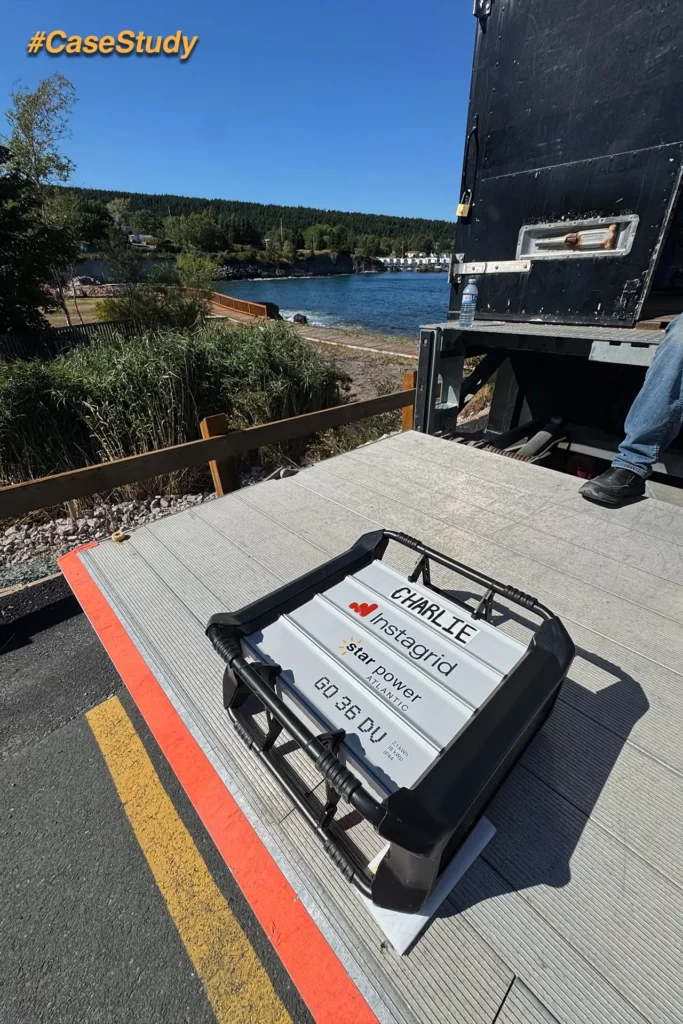
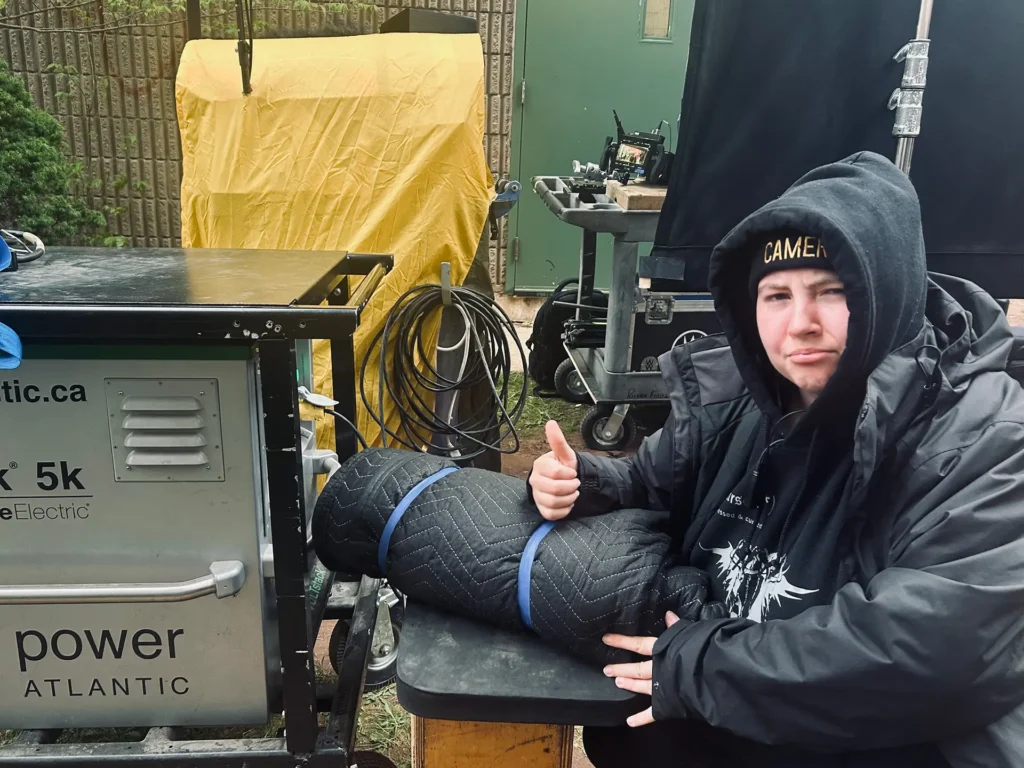
To support production, Star Power Atlantic supplied a Voltstack 5K all-terrain portable battery energy storage system. On The Snake, it became a flexible source of quiet, portable power that moved with the crew and adapted to different use cases across the shoot.
It was used on the truck, off the truck, inside locations, and out on exteriors. It helped with charging, supported lighting workflows, and provided power where the team needed it without introducing the noise and hassle of a traditional gas setup.
What stood out most was how uneventful it became.
“The biggest compliment I could give is that we almost never talked about the Voltstack because we didn’t have to.”
Melani Wood, Producer
That is high praise on a film set. Power only becomes a topic when something is loud, late, empty, broken, or in the way. The Voltstack did what good on-set infrastructure should do: it worked, stayed quiet, and let the crew focus on the film.
How The Snake Used the Voltstack on Set
Because The Snake was a smaller feature, the Voltstack was not isolated to one department. It became shared infrastructure across production.
Wood pointed to Stuart Rankin, the Best Grip on the production who helped oversee the unit on set, as a key boots-on-the-ground problem solver, while cinematographer Kevin Fraser and gaffer Jay Goodyear were already familiar with the technology. Rankin, working closely with the Grip and Lighting team, said the Voltstack quickly became part of the crew’s daily workflow.
“The primary purpose of the Voltstack 5K on The Snake was as a mobile support station for our Grip and Lighting team. Independent film often requires us to find ways to stay lightweight and low-impact, minimizing our footprint in the communities where we work. The Voltstack travelled on our grip truck and served as a mobile power plant, keeping batteries and LED lighting fixtures charged and ready even when we couldn’t set up a generator or run power from a building. We also didn’t have to worry about disrupting residents when we needed power on the streets of Charlottetown with the noise and air pollution of gas generators. Charging the unit overnight was as simple as running a line from inside to the back of the truck.”
Stuart Rankin, Best Grip
Fraser described one especially useful application on The Snake: using the Voltstack as a mobile overnight charging station.
“One thing that we used it for a lot on The Snake, specifically, is that we were able to use it as a charging station for all of our Titan tubes, of which we had quite a few, overnight on the truck. So it really made it so we basically had a locked-up mobile charging station at night, which was super helpful.”
Kevin A. Fraser, Cinematographer
Rankin also pointed to moments when the unit’s portability made certain shots possible that would have been difficult with traditional generators.
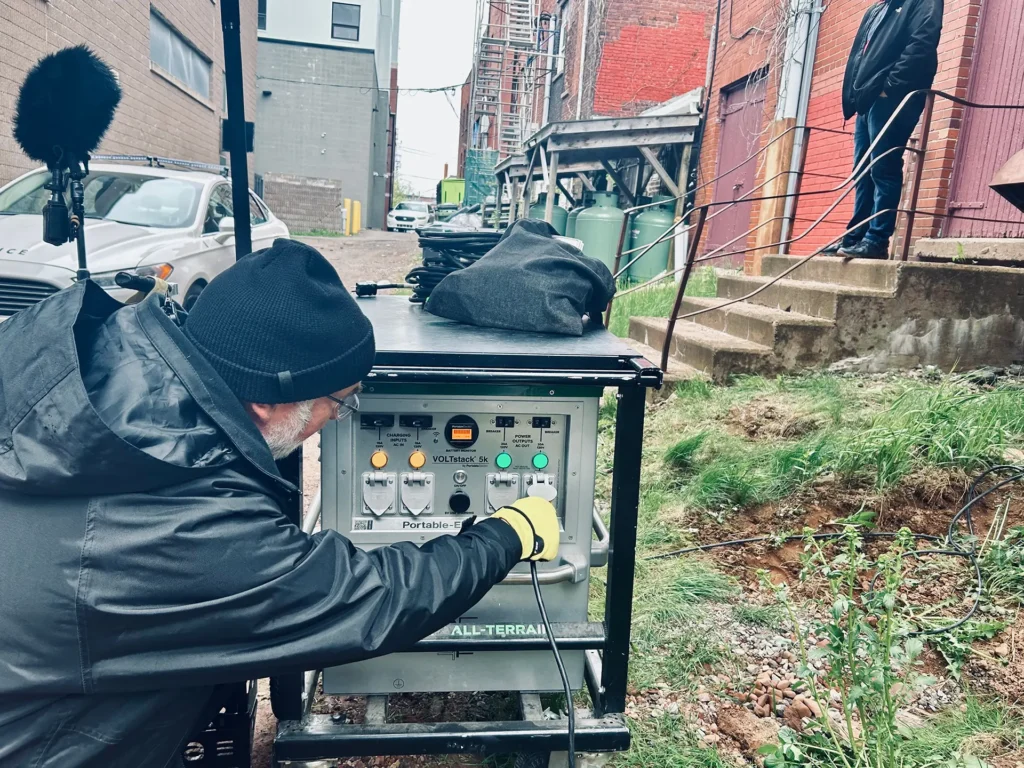
“There were a couple of occasions where we needed a light some distance from our primary shooting location and couldn’t run cable. One was a spotlight in a parkade next to an alleyway, and another was a last-minute Skypanel on a street corner across the road. We only needed them long enough to get the shot, but those setups would have been tricky, maybe impossible, with traditional power generation on our limited resources. The 5K allowed those fixtures to be self-sufficient for the time we needed. It’s really expanded what’s possible for smaller crews in today’s market.”
Stuart Rankin, Best Grip
The unit also proved useful in more technical ways. Fraser noted that the Voltstack can combine standard household circuits to create a larger usable power source on set. By feeding two 15-amp household circuits into the unit, the crew could draw a stable 20-amp output capable of powering larger lighting fixtures without tripping a breaker. In older locations where electrical infrastructure is limited, that capability can make a real difference and often saves crews from running long cable runs across a set.
Across the shoot, the unit supported overnight charging for lighting gear, battery charging on the truck, exterior setups, and even tent heating during cold-weather work. Because it was portable and easy to position once truck logistics were planned correctly, it could go where production needed it rather than forcing departments to work around fixed power sources.
The Results: Quiet Reliability and a Lower-Friction Shoot
Not every production has perfect carbon accounting. On The Snake, the strongest results were operational, practical, and visible to the crew.
The Voltstack helped the production eliminate reliance on conventional gas generators, avoid noise issues in community-based locations, protect relationships with location owners, keep fuel use low, and avoid turning power into a scheduling problem.
That last point mattered. For a roughly 15-day shoot built around ten-hour days, that kind of invisible reliability is a meaningful win.
Without the Voltstack, the likely alternatives would have been familiar ones: small gas generators, longer cable runs, location tie-ins, fuel management, and the kind of improvised solutions crews have always used. Portable battery energy storage did not eliminate every production challenge on The Snake, but it removed one category of friction that crews have long accepted as normal.
Service and Support Matter as Much as the Equipment
A useful product still needs to be accessible. That came through clearly in the interview.
Wood praised the ease of working with Star Power Atlantic and Pascal Gellrich directly, especially on a modest-budget feature where complexity can quickly kill good intentions.
“When you make it easy, then I have no excuse not to do it.”
Melani Wood, Producer
That is what clean power adoption on set really depends on. Not just better technology, but technology that is practical, responsive, and easy to integrate into a real shoot.
For The Snake, planning began early, and the crew adjusted truck logistics, including lift-gate access, to facilitate movement. The result was a setup that worked in the field, not just in theory. By the time the production was underway, the equipment had become part of the workflow rather than a talking point. As cinematographer Kevin Fraser put it, “We’re kind of hooked on it.”
Quiet Power, Right Before the Spotlight
By the time The Snake screens in Austin, the audience will see the performances, the tension, the humour, and the film’s final shape. What they will not see is the overnight charging station on the truck, the quiet power source that stayed out of the way, or the small technical choices that helped the production move through PEI with more care.
That is often what progress looks like on set. Not loud. Not flashy. Just effective.
Before The Snake steps onto an international stage at SXSW, this production already offers a compelling example of what clean, portable power can look like in practice: quieter sets, fewer compromises, better community fit, and a production team that never had to make power the problem.